
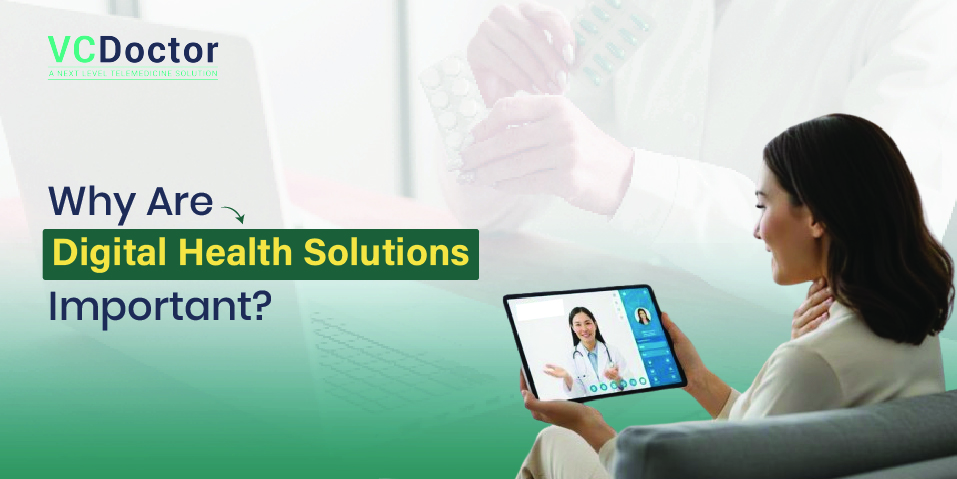
Why Are Digital Health Solutions Important?
The health sector has emerged as a vital part of one’s life. From mHealth to telemedicine, the sector is transforming like anything. In a broad sense, it refers to the utilization of technologies like health information technology (HIT), wearable devices, telehealth, telemedicine, and personalized medicine to overcome health issues more diligently. The article conveys a deeper sense of Digital Health. Read out why digital health solutions are important in the healthcare industry?
Artificial Intelligence (AI) and Machine Learning (ML) have become core components of modern digital health, not just supporting technologies. AI now assists with diagnostic imaging analysis, predicts patient risk before symptoms escalate, and powers voice-to-prescription tools that reduce documentation time for physicians. Combined with real-time patient data, AI helps clinicians move from reactive treatment to proactive, preventive care, spotting patterns a human reviewer might miss across thousands of data points.
What are Digital Health Solutions?
The conjunction of digitalization with health, healthcare, living, and the society we live in to promote effective healthcare practice delivery is known as Digital Health Solutions. The regimen includes the utilization of information and negotiation techniques to flourish an understanding of health problems.
Digital Health is an associative domain consisting of multiple stakeholders, physicians, scientists, etc. It includes both software and hardware solutions and services, along with other digital technology advances.
Names of Different Digital Health Solutions
Now the section expresses the trending digital ways adopted in the healthcare sector for better treatment and patient management possibilities:
- Telemedicine
- Wearable Technology
- AR & VR Technique
- Other Digital Health Solutions
Telemedicine
Telemedicine is the newest and most important criterion of digital health solutions. Platforms like VCDoctor and others are doing well in providing remote patient monitoring (RPM). VCDoctor is one of the pioneer tools that is HIPAA-compliant, which helps in accessing remote patients and treatment.
Telemedicine mainly covers medical records, remote care, appointment booking, self-symptom checkers, etc., facilities. Telemedicine also accommodates online health records, which are accessible to both patient and doctor at any time.
Wearable Technology
Wearable advances come in various aspects, i.e. smartwatches, on-body sensors, health bands, etc. Smartwatches and bands are the first choice of users to keep track of their health and other health issues.
The devices can be paired up with cell phones or other devices to give an analysis of the daily health status. Records like BMI, Blood Pressure, Heart Rate, Calories Burnt, Physical Activity patterns, etc., can be easily monitored with these devices.
With the new technological era, the telemedicine aspect is extending to smart bodywear, like patches, clothes, and accessories, etc. These wearable devices are utilized to track patients’ health status daily. By relying on the data obtained from these wearables, doctors and physicians can plan more significant outcomes.
Augmented Reality (AR) & Virtual Reality (VR)
AR technology is utilized for constructing robust smart devices for healthcare professionals. The technology utilizes real-world experience and computer-based sensory information to provide health data.
Since the patient-oriented information comes from handy smart devices, Smart glasses are something that gives a fresh and hands-free augmented way of treating the patient. The applications can give the best outcomes, like data-driven diagnosis, AR-Based patient documentation, advancing the treatment criteria for patients, etc.
Other Health-Related Solutions
Some more advances have paved the way to epic health treatments, i.e. Assistive Technologies, rehabilitation robotics, and unobtrusive monitoring sensors, etc., that can help people with some deformities. These functionalities are designed to be repeatable, replicated, and applied to any research data.
These were all the digital health solutions that have gained so much popularity in recent years. There is no rigid working or any other aspect. The technology offers more convenient and accurate results. Now, the section will conclude the benefits of such technology in the healthcare industry.
Not Sure Which Digital Health Solutions Fit Your Practice?
Get a personalized recommendation based on your specialty, patient volume, and digital healthcare goals.
Schedule a Free ConsultationDigital Health Frameworks Around the World
Governments worldwide are now building national digital health infrastructure to standardize how patient data, provider identity, and health facilities are managed. In India, the Ayushman Bharat Digital Mission (ABDM) connects patients, doctors, and healthcare facilities through a unified digital health ecosystem. Meanwhile, in the UAE, NABIDH and DHA establish standards for managing and protecting digital health data in Dubai. Across Europe, GDPR sets strict requirements for protecting personal and health data. These frameworks matter because they shape what “digital health” looks like in practice, moving it from a collection of individual apps to a connected, regulated ecosystem.
Interoperability: How Digital Health Systems Communicate and Share Data
One of the biggest challenges in digital health isn’t a lack of tools; it’s getting those tools to communicate with each other. A patient’s records shouldn’t be trapped in one healthcare system and inaccessible when they visit a different clinic or specialist. Interoperability standards such as HL7 and FHIR help different platforms, EMRs, and healthcare devices exchange data in a standardized way, giving providers a more complete view of a patient’s health history regardless of where the data originated. Without interoperability, digital health tools remain isolated systems rather than becoming part of a connected care ecosystem.
Why is Digital Health Important?
Digital Healthcare Tools is the more precise way of getting an account of a patient’s health. It gives access to data and gives more control over the health parameters. Simultaneously, the technique provides real opportunities to improve medical reports and enhance efficiency.
After getting a better sight to the characteristics, let us understand the benefits of utilizing these Digital Health Solutions in the healthcare sector:
- Reduce Inefficiencies
- Improved Accessibility
- Cost-effective
- Improvised Quality
- Personalized Medication for Patients
1. Reduce Inefficiencies
When dealing with patients’ data on paper, charts or graphs, etc., it becomes less effective to maintain all the records. Digitalization in every sector works like an elixir that reduces paperwork and magnifies the digital health records for better diagnostic opportunities.
2. Improved Accessibility
It enhances the accessibility of data for both sides, i.e., the patient and the doctors. One can access their health records at any time, and physicians can predict the best treatments. For better results, these records are shared via Electronic Health Record (EHR) to the best doctors in the world for better cures and diagnosis of diseases.
3. Cost-Effective
Digital health solutions are based on low-cost aspects. One can drive effective medical reports by investing less money. It also reduces the costs of using the machines and electronic devices, as the reports are generally obtained from the tools themselves. Various platforms like VCDoctor for Telemedicine and other specialists have developed tools to shorten the time invested in generating health records.
4. Improved Quality
The medical side of the patient has been improved enormously after the involvement of digital health tools. These technologies, like wearable devices, artificial intelligence, mHealth, Telemedicine, etc., give super flexibility in obtaining the most accurate health statistics of the patients. Simultaneously, on the physician’s end, the data gives them accessibility to better diagnose the patient’s health, personalized medicines, etc.
5. Personalized Medication for Patients
The medication offered to patients through solutions such as RPM, mHealth, and telemedicine services can be personalized according to their individual needs. During a clinic visit, doctors may prescribe medications that are not always the most effective, as physicians often manage multiple patients. However, by using these digital healthcare options, physicians can better understand a patient’s health status and recommend more personalized treatment.
Challenges to Digital Health Adoption
Data Privacy and Security – As more health data moves online, protecting it against breaches becomes a growing responsibility for every provider and platform involved.
Digital Access Gaps – Not every patient has reliable internet or a smart device, which can create new inequalities in access to care if digital tools aren’t paired with alternative options.
System Integration Complexity – Many healthcare organizations still run on legacy systems, making it difficult to adopt new digital tools without significant investment in integration.
What is Real-Time Data in Healthcare?
Real-time healthcare data gives physicians timely insights into a patient’s health status, allowing them to monitor important health metrics beyond periodic check-ups. By tracking and analyzing this data as it becomes available, healthcare providers can identify potential changes earlier, support proactive care, improve treatment management, and potentially reduce avoidable hospital visits and readmissions.
Ready to Bring Digital Health to Your Practice?
From telemedicine and remote patient monitoring to AI-powered tools, build a secure, scalable digital health platform tailored to your practice.
Contact Us TodayConclusion
Digital health is no longer optional. It’s becoming the foundation of how care is delivered. From telemedicine and mHealth to remote patient monitoring and AI-powered solutions, digital technologies are helping healthcare providers improve access, streamline workflows, and deliver more connected care.
As adoption continues to grow, healthcare providers need solutions that are not only innovative but also secure, scalable, and easy to integrate into existing workflows. Platforms like VCDoctor are helping providers bring digital health technologies into their practices while creating a more connected experience for both providers and patients.
The future of healthcare isn’t simply digital. It’s connected, accessible, and increasingly patient-centered.
FAQs
Telemedicine is one part of digital health, specifically remote consultations. Digital health is the broader category, covering telemedicine along with wearables, AI diagnostics, EHRs, and other technology used to manage and deliver care.
They reduce inefficiencies, improve accessibility to care, lower costs, and enable more personalized, data-driven treatment, benefiting both patients and healthcare providers.
Telemedicine platforms like VCDoctor are a common example, enabling remote consultations, e-prescriptions, and remote patient monitoring through a secure, HIPAA-compliant platform.
Reputable digital health platforms use encryption, access controls, and compliance frameworks like HIPAA or GDPR to protect patient data, but security depends on the specific platform and how well those safeguards are implemented.
AI supports digital health through diagnostic assistance, predictive risk analysis, and administrative automation, helping physicians make faster, more informed decisions without replacing clinical judgment.

After the covid pandemic, digital health solutions are very important for every country. This post contains all information is facts and digital health is the future.